

TEL:+86-18936253998


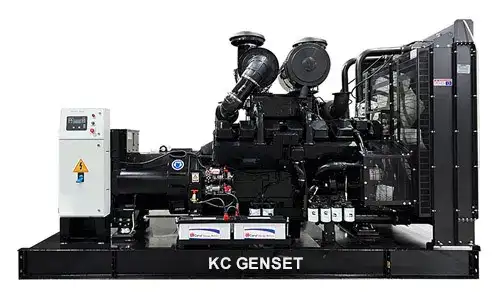

The most common complaint we get in Indonesia isn't machine failure—it's customers feeling short on power. A 500kVA Indonesia silent generator set tested on site at full load only delivers around 430kVA. Customers say we under-rated the unit. No—you just didn't account for ambient temperature's effect on power. Let me break this down clearly.
Power derating: not a machine defect, just hot humid air
The standard rating condition for any genset is 25°C ambient, sea level. Check the fine print in any manual. Most of Indonesia averages 30-32°C, hitting 35-38°C at midday, with 80-95% humidity. Air density is roughly 10-12% lower than standard conditions.
Diesel engines burn oxygen from the air. Lower air density means less oxygen in each cylinder. Inject the same amount of fuel and it won't burn completely. The ECU reduces fuel delivery accordingly—power drops. That's derating. Not a defect.
How much derating? Per ISO3046 correction formula, going from 25°C to 35°C reduces power by 8-10%. A 500kVA machine running at midday in Jakarta delivers roughly 450kVA usable. Normal.
Our solution: recalculate power for 40°C ambient
Not a better machine—a larger one. If you need 500kVA actual output, back-calculate the nameplate rating for 40°C: 500 ÷ 0.9 = 555kVA. So a genset nameplated at 600kVA delivers 500kVA at midday in Jakarta.
Many procurement people don't know this logic. Many suppliers don't explain it. Our approach: attach the correction calculation sheet at the quotation stage. Show both numbers—"nameplate power" and "actual power at your site conditions." Users see it themselves. No guesswork.
Cooling challenge with silent gensets
A silent generator set in Indonesia is harder to cool than an open type. The acoustic enclosure wraps around the machine. Limited intake area. Exhaust only in one direction. High ambient plus enclosure adds another 5-8°C inside.
We've torn down several other brands' silent units. Common problem: the enclosure designer focused only on noise reduction, not cooling. Intake area too small. Exhaust duct angle wrong. Hot air exits then recirculates back in.
Our solution: intake area at least 30% of the unit's footprint (industry average is around 20%). Exhaust duct with a curved elbow forcing hot air upward. Baffles between alternator and engine to prevent hot air recirculation. Radiator another 5% larger than open-type spec.
These changes cost money. But they work. Just commissioned two 800kVA silent units at a Sulawesi mine last week. Site conditions: 34°C, 88% humidity. Six continuous hours at full load. Maximum coolant temperature: 93°C.
Remote monitoring: not a value-add in Indonesia—it's standard
Archipelagic logistics. Flying a technician from Jakarta to an outer island costs $1,000+ just in flights, hotels, local transport. Frequent on-site visits are not realistic.
Every Indonesia silent generator set we ship has a factory-standard 4G remote telemetry module. Our engineers in Jiangsu see real-time data from a mine in Kalimantan—coolant temp, oil pressure, load percentage, voltage, frequency. We get alerts before trends become failures.
Last month, a Kalimantan customer's system flagged low battery charging voltage on one unit. We told the site electrician to check. Found a loose connection on the float charger. Tightened it. Problem solved. Flying someone there would have cost three days of travel plus enough expense to buy a new battery.
Corrosion protection is not optional
High humidity plus coastal salt spray will turn an unprotected genset into scrap in two years. Our Indonesia units ship with: three-layer paint (primer + top coat + clear coat), zinc-nickel alloy fasteners, IP23 control box plus anti-condensation heater. Not spec sheet decoration—the kind of protection where you open a control box after four years on Batam Island and it's still dry inside.
Core sizing logic
Thinking about silent generator set selection in Indonesia needs a different approach than domestic:
Power: correct for local ambient. Size up, not down.
Cooling: not just radiator size—intake and exhaust design on the enclosure matters more.
Monitoring: remote telemetry is not optional.
Corrosion: don't cut this corner. Indonesia's humidity doesn't negotiate.

Scan to add WhatsApp

Provide your specific electricity needs